Dust from a fragmented asteroid may cause a spectacular meteor shower on Venus, posing observational challenges from Earth
Meteor shower Venus: a dust trail from an ancient asteroid breakup could create a meteor shower on Venus this July, yet Earth-based observation remains difficult.
Meteor shower Venus: a rare celestial event
Venus is set to experience a significant meteor shower on July 5, 2026, caused by a trail of dust originating from an asteroid that shattered thousands of years ago. This phenomenon, known as the “meteor shower Venus,” is a rare event linked to the dynamic environment near our sun and the intricate orbits of celestial bodies within the inner solar system.
The origin story: two asteroids on a shared orbit
Astronomers discovered two asteroids, designated 2021 PH27 and 2025 GN1, orbiting closer to the sun than Earth and passing near Venus. Both share remarkably similar orbits and spectral characteristics, belonging to a rare group called Atira asteroids. Their orbit periods are the fastest recorded for asteroids in our solar system, completing a sun circuit in just 115 days.
Due to the similarity of their orbits and composition, researchers hypothesized these two asteroids were once a single larger body.
The breakup mechanism near the sun
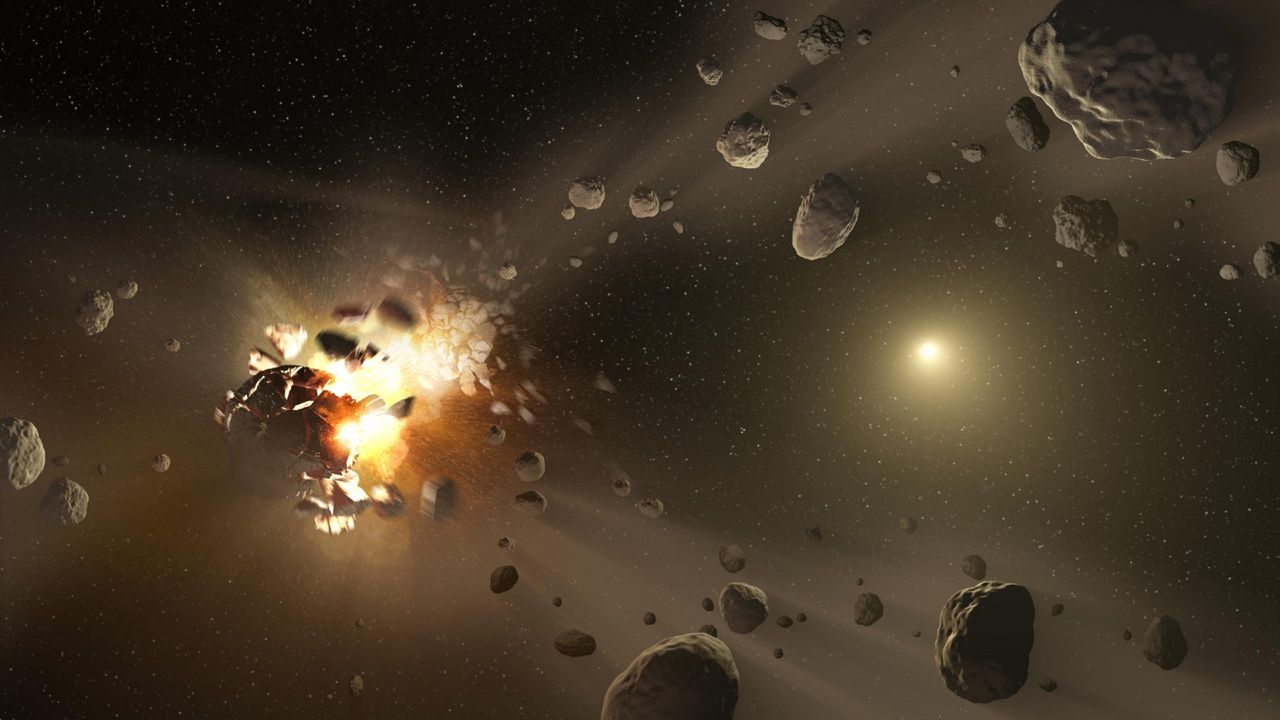
Simulations tracing their orbits back 100,000 years revealed that the parent asteroid once approached the sun as close as 15 million kilometers — about four times closer than Mercury’s average orbit. The intense solar heating would have caused surface fractures and weakened the asteroid’s structure. As it rotated, the YORP effect (thermal radiation torque) likely increased its spin rate, eventually breaking it apart into two fragments between 17,000 and 21,000 years ago.
This breakup scattered dust and debris into space, which has not yet dissipated, maintaining a dust stream that Venus will encounter.
Venus crossing the dust stream: the meteor shower
Models predict Venus will pass through this dust stream in July 2026, triggering a meteor shower visible from Venus’s atmosphere. This event would be somewhat analogous to Earth’s Geminid meteor shower, which is caused by debris from asteroid Phaethon.
However, observing this meteor shower from Earth is challenging. Only exceptionally bright fireballs, with magnitudes between -12 and -15 (similar in brightness to the moon), could be detected from our vantage point.
Prospects for future observations
Direct observation of this meteor shower would ideally require spacecraft in Venus orbit. Currently, no active missions are positioned there, but future projects such as the European Space Agency’s EnVision mission, planned for launch around 2031-2032, or NASA’s proposed DAVINCI and VERITAS missions, could provide direct monitoring.
Such observations would enhance understanding of asteroid fragmentation processes near the sun and the dynamics of meteor showers on planets other than Earth.
Fonte: www.space.com